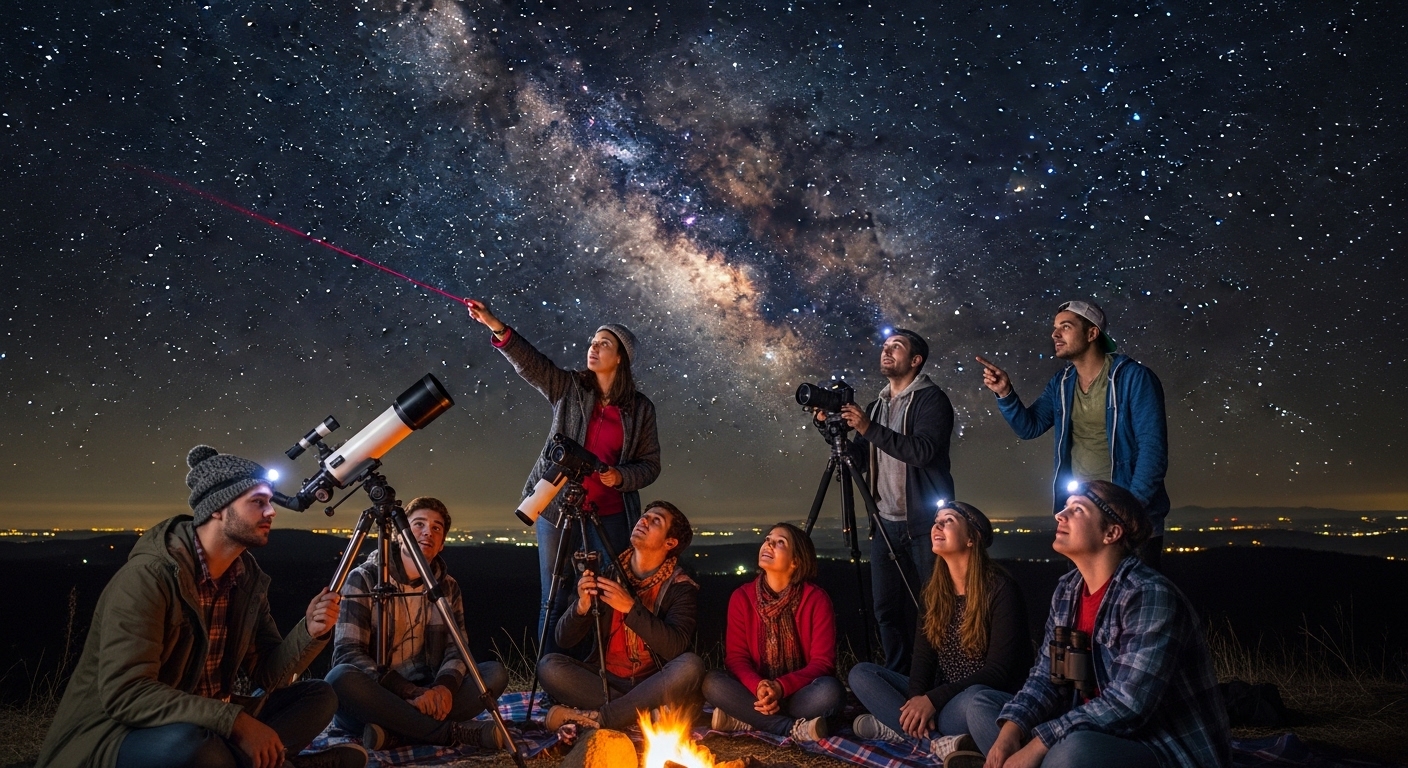
Stargazing has evolved from a niche scientific interest into a widely appreciated astronomy hobby among young people around the world. With increasing access to educational content, smartphone apps, and affordable telescopes, more individuals are becoming curious about the night sky and the vast universe beyond Earth. Stargazing offers a unique blend of science, relaxation, and exploration, making it appealing to students, hobbyists, and science enthusiasts alike.
In recent years, night sky observation has gained popularity due to growing interest in space exploration and astronomy education. Events such as planetary alignments, meteor showers, and lunar eclipses attract global attention through social media and online communities. Young people, inspired by space missions and scientific discoveries, are increasingly exploring space learning through practical observation of stars and celestial objects.
Unlike many modern activities dominated by screens, stargazing encourages people to step outdoors and experience the universe directly. Observing the night sky helps develop curiosity, patience, and a deeper appreciation for science and nature. As awareness of astronomy grows, this ancient practice is finding new relevance among modern learners.
Why Young People Are Interested in Night Sky Observation
One major reason stargazing is becoming popular among young astronomy enthusiasts is the accessibility of information about space. Online platforms, educational videos, and astronomy communities make it easier than ever for beginners to learn about stars, planets, and galaxies. This access to knowledge fuels curiosity and encourages individuals to explore the night sky themselves.
Technological tools also contribute significantly to this trend. Smartphone apps can identify stars, constellations, and planets in real time simply by pointing the phone toward the sky. These tools make night sky observation more interactive and educational. Instead of memorizing star charts manually, beginners can quickly locate celestial objects and understand their positions in the sky.
Another reason young people enjoy stargazing is the sense of wonder it creates. Observing distant planets or the Milky Way galaxy can inspire a feeling of connection to the universe. This emotional experience often motivates individuals to learn more about astronomy and space science. For many students, stargazing becomes the starting point for deeper interest in space learning and scientific exploration.
Telescope Basics for Beginner Stargazers
Understanding telescope basics is an important step for those who want to explore the night sky in greater detail. While stargazing can be done with the naked eye, telescopes allow observers to see planets, star clusters, and other celestial objects more clearly. Beginners often start with small telescopes that are easy to use and transport.
Telescopes generally fall into three main categories: refractors, reflectors, and compound telescopes. Refractor telescopes use lenses to magnify objects, while reflector telescopes use mirrors to gather light. Compound telescopes combine both technologies to provide versatile viewing options.
The following table outlines common telescope types used in astronomy hobby activities.
| Telescope Type | Main Feature | Best Use |
|---|---|---|
| Refractor telescope | Uses lenses for magnification | Planet observation |
| Reflector telescope | Uses mirrors to gather light | Deep-sky objects |
| Compound telescope | Combination of mirrors and lenses | Versatile viewing |
| Portable telescope | Lightweight design | Travel and outdoor viewing |
| Beginner telescope | Simple setup and controls | Learning telescope basics |
Choosing the right telescope depends on the user’s goals and level of experience. Beginners often start with affordable models designed for easy setup and basic night sky observation.
Educational Benefits of Stargazing
Stargazing is more than just a relaxing activity; it also offers significant educational benefits. Observing the night sky encourages scientific thinking and curiosity about the universe. Young astronomy enthusiasts often learn about celestial mechanics, star formation, planetary motion, and cosmology through practical observation.
Night sky observation also supports STEM education by introducing students to scientific methods and observation techniques. When observing stars or tracking planetary movement, learners practice patience, measurement, and analysis. These skills are essential in many scientific disciplines.
Space learning through stargazing also fosters interdisciplinary understanding. Astronomy connects with physics, mathematics, chemistry, and even history. For example, studying constellations reveals how ancient civilizations interpreted the sky and navigated using stars. Understanding these connections enriches the learning experience and broadens perspectives.
In addition, astronomy hobby activities can inspire future careers in science and technology. Many astronomers and space scientists began their journey by observing the night sky as children or teenagers. Early exposure to stargazing can therefore influence educational choices and long-term career interests.
Best Conditions for Stargazing
Successful stargazing depends on environmental conditions and preparation. One of the most important factors is finding a location with minimal light pollution. Urban areas often have bright artificial lights that make it difficult to see faint stars. Traveling to rural or remote locations significantly improves night sky observation.
Weather conditions also play a role. Clear skies with low humidity provide the best visibility for observing celestial objects. Cloud cover or atmospheric turbulence can obscure stars and reduce viewing quality. Many astronomy enthusiasts check weather forecasts and astronomical calendars before planning observation sessions.
Timing is another important consideration. Certain astronomical events such as meteor showers, planetary alignments, or lunar eclipses provide exceptional opportunities for observation. Learning telescope basics and understanding celestial timing helps observers make the most of these events.
Patience is also essential. The human eye takes time to adapt to darkness, and subtle celestial objects may require careful observation. With practice and experience, stargazers develop better skills for identifying constellations and tracking celestial movements.
The Growing Community of Astronomy Enthusiasts
As interest in stargazing grows, communities of astronomy enthusiasts are forming both online and offline. Amateur astronomy clubs organize observation events where members share equipment and knowledge. These gatherings create opportunities for beginners to learn from experienced observers.
Online communities also play a significant role in promoting the astronomy hobby. Social media platforms allow enthusiasts to share photographs, observation tips, and educational resources. Astrophotography, which combines photography with astronomy, has become particularly popular among young stargazers.
Educational institutions and science centers are also supporting interest in space learning by organizing workshops, public observation nights, and astronomy camps. These initiatives encourage people of all ages to explore the universe through practical experience.
As technology continues to evolve, tools such as automated telescopes and advanced observation apps will make stargazing even more accessible. These innovations are expected to further expand the global community of amateur astronomers.
Final Thought
Stargazing is rapidly becoming a popular astronomy hobby among young enthusiasts because it combines scientific curiosity with a sense of wonder about the universe. Through night sky observation, telescope basics, and engaging space learning experiences, individuals can explore celestial objects and deepen their understanding of astronomy. As technology and education continue to make space exploration more accessible, stargazing will remain an inspiring gateway into the vast and fascinating world of the cosmos.