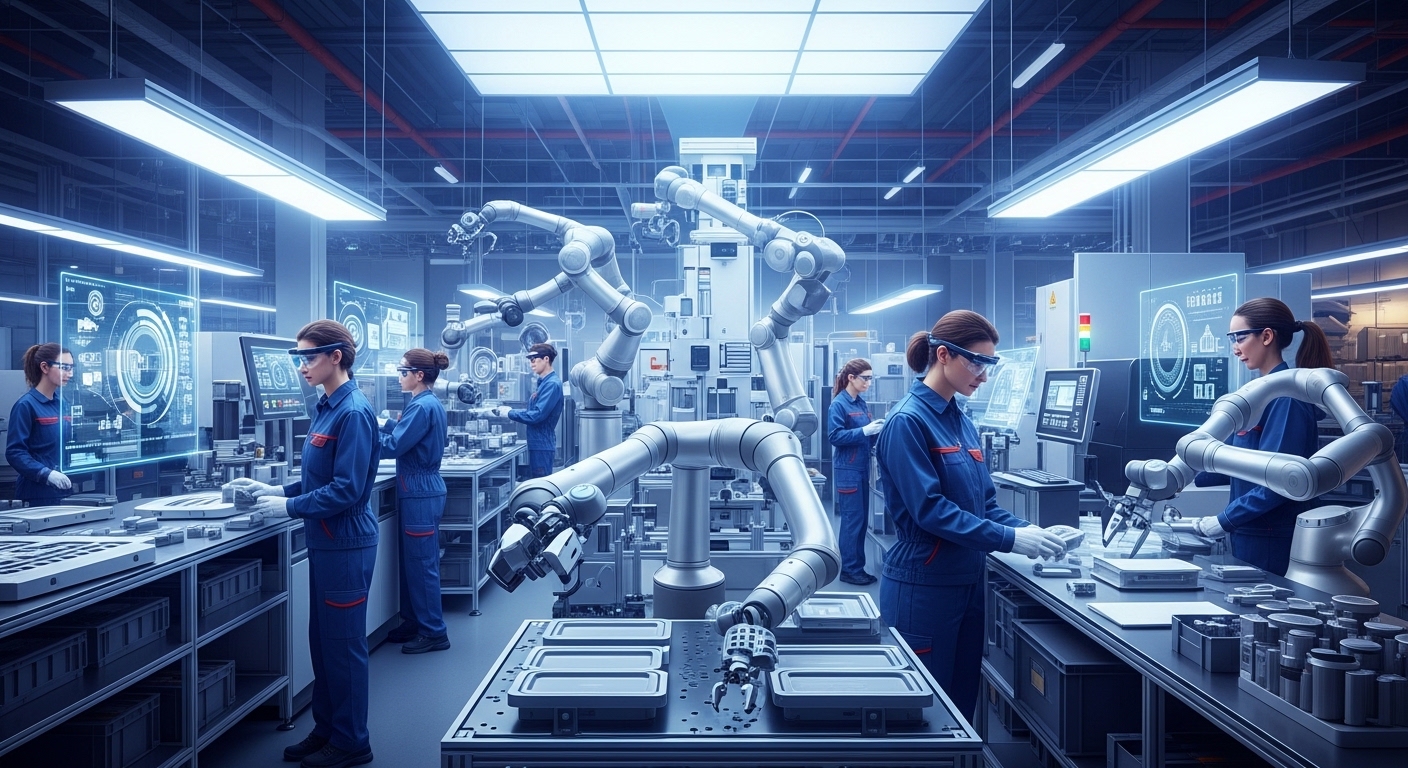
Manufacturing is entering a new phase of transformation known as Industry 5.0, a concept that builds upon the digital automation advances of Industry 4.0 while placing humans back at the center of industrial systems. Whereas earlier industrial revolutions focused on mechanization, electrification, and automation, Industry 5.0 emphasizes collaboration between advanced technologies and human creativity. This shift reflects the growing recognition that sustainable industrial innovation requires not only intelligent machines but also skilled, empowered people.
The global manufacturing landscape is becoming increasingly complex due to rapid technological change, shifting consumer demands, and sustainability pressures. Smart factories powered by automation trends have improved efficiency and precision, yet they also raised concerns about workforce displacement and over-automation. Industry 5.0 addresses these challenges by promoting human centric manufacturing, where machines enhance human capabilities rather than replace them. This balanced approach is shaping the future of production systems across industries.
Understanding the Core Principles of Industry 5.0
Industry 5.0 is built on three core principles: human centricity, sustainability, and resilience. Human centric manufacturing ensures that technological systems are designed around worker well-being, safety, and skill development. Sustainability focuses on environmentally responsible production and resource efficiency. Resilience emphasizes adaptable and flexible manufacturing systems capable of responding to disruptions and changing demand.
Unlike Industry 4.0, which primarily prioritized automation and data connectivity, Industry 5.0 integrates human expertise with intelligent machines. Collaborative robots, AI-assisted decision systems, and augmented reality tools enable workers to perform complex tasks more effectively. This integration allows manufacturers to achieve both efficiency and customization without sacrificing human oversight.
The comparison below highlights key differences between Industry 4.0 and Industry 5.0 manufacturing paradigms.
| Aspect | Industry 4.0 | Industry 5.0 |
|---|---|---|
| Primary Focus | Automation and digitalization | Human–machine collaboration |
| Workforce Role | Reduced manual involvement | Enhanced human creativity |
| Production Style | Mass production | Mass customization |
| Technology Goal | Efficiency and connectivity | Sustainability and resilience |
| Factory Model | Fully automated smart factories | Human centric smart factories |
This transition demonstrates how Industry 5.0 expands the goals of industrial innovation beyond productivity to include social and environmental value.
Human Centric Manufacturing and Workforce Transformation
Human centric manufacturing is a defining characteristic of Industry 5.0. In this model, workers are not replaced by automation but supported by advanced tools that amplify their skills. Collaborative robots, known as cobots, operate alongside humans to handle repetitive or physically demanding tasks, allowing workers to focus on complex decision-making and creative problem-solving.
Training and upskilling are essential components of this transformation. As automation trends reshape job roles, employees require digital literacy, data interpretation, and system management skills. Industry 5.0 encourages lifelong learning and continuous skill development to ensure that workers remain integral to manufacturing systems. This approach enhances job satisfaction and productivity while reducing resistance to technological adoption.
Worker well-being is also prioritized in Industry 5.0 environments. Ergonomic workstations, intelligent safety systems, and adaptive production interfaces reduce physical strain and workplace hazards. By designing smart factories around human needs, manufacturers can improve both performance and workforce retention.
Smart Factories and the Rise of Mass Customization
Smart factories remain central to Industry 5.0, but their purpose is evolving. Instead of focusing solely on automation and throughput, Industry 5.0 smart factories emphasize flexibility and customization. Modern consumers increasingly demand personalized products tailored to specific preferences, from customized electronics to individualized medical devices. Meeting this demand requires production systems capable of rapid adaptation.
Advanced automation trends such as AI-driven production planning, digital twins, and real-time data analytics enable manufacturers to adjust processes quickly without sacrificing efficiency. Human oversight ensures quality control and creative design adjustments that machines alone cannot achieve. This synergy between humans and technology supports mass customization at industrial scale.
Flexible smart factories also strengthen supply chain resilience. During disruptions such as material shortages or demand shifts, adaptable production systems can reconfigure workflows and product lines rapidly. Industry 5.0 therefore contributes to more robust and responsive manufacturing ecosystems.
Sustainability and Responsible Industrial Innovation
Sustainability is a core pillar of Industry 5.0, reflecting growing global concern about environmental impact and resource consumption. Traditional manufacturing models often prioritized output and cost reduction, sometimes at the expense of ecological responsibility. Industry 5.0 promotes industrial innovation that balances productivity with environmental stewardship.
Energy-efficient machinery, waste-reduction processes, and circular economy practices are increasingly integrated into smart factories. AI-based monitoring systems optimize energy usage and material efficiency, while human decision-makers ensure ethical and sustainable production choices. This collaboration helps manufacturers reduce emissions and environmental footprint without compromising competitiveness.
Sustainable manufacturing also aligns with regulatory and consumer expectations. Companies adopting Industry 5.0 principles can meet environmental standards more effectively and enhance brand reputation. As sustainability becomes a strategic priority, Industry 5.0 provides a framework for responsible industrial growth.
Future Outlook of Industry 5.0 in Global Manufacturing
The influence of Industry 5.0 on manufacturing is expected to expand significantly in the coming years. As automation trends continue to evolve, the integration of human expertise with intelligent systems will become increasingly important. Technologies such as artificial intelligence, augmented reality, and advanced robotics will further enhance human–machine collaboration.
Global competition and supply chain complexity will also accelerate adoption of resilient and flexible manufacturing systems. Industry 5.0 smart factories capable of rapid reconfiguration and customization will be better positioned to meet changing market demands. Governments and industry organizations are already promoting policies and standards that support human centric manufacturing and sustainable industrial innovation.
Education and workforce development will play a crucial role in this transition. Preparing workers for collaborative technology environments will ensure that Industry 5.0 achieves its goal of inclusive and balanced industrial progress. As adoption grows, Industry 5.0 is likely to redefine manufacturing not only as a technological system but also as a human-centered ecosystem.
Final Thought
Industry 5.0 represents a transformative evolution in manufacturing that combines automation trends with human centric manufacturing and sustainable industrial innovation. By integrating smart factories with human creativity and ethical responsibility, Industry 5.0 is shaping a future where technology enhances rather than replaces human potential. This balanced approach will enable manufacturing industries to become more adaptive, resilient, and socially responsible in the decades ahead.