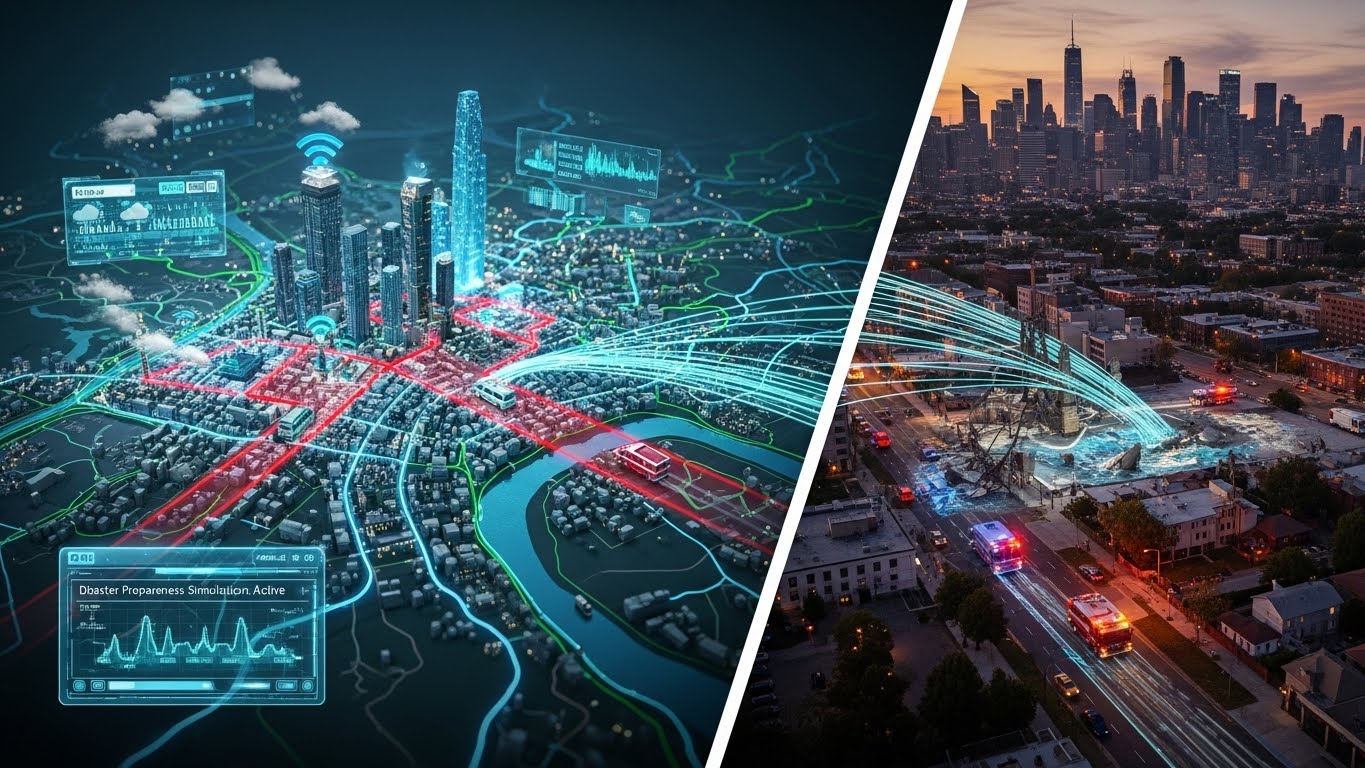
Digital twin cities are transforming how urban areas prepare for, respond to, and recover from disasters. As cities grow denser and climate-related risks increase, traditional planning methods often fall short in anticipating complex emergencies. Digital twin cities use virtual replicas of physical urban environments to model real-world conditions in real time. These systems combine data from infrastructure, sensors, and historical records to create dynamic city simulations. By enabling advanced emergency planning, realistic simulations, and stronger urban resilience, digital twin cities are becoming a critical tool for modern disaster preparedness.
Understanding Digital Twin Cities and Their Core Concept
Digital twin cities are virtual representations of physical cities that mirror real-world assets such as buildings, roads, utilities, and population movement. These digital models continuously update using live data, allowing planners to observe how a city behaves under different conditions. Unlike static maps or plans, digital twin cities evolve alongside the real environment. This capability allows authorities to test scenarios without risking lives or infrastructure. By visualizing how disasters may unfold, city planners gain deeper insight into vulnerabilities and response strategies, strengthening preparedness and decision-making.
Role of Digital Twin Cities in Emergency Planning
Emergency planning requires accurate forecasting and coordination across multiple agencies. Digital twin cities enhance emergency planning by providing a shared, data-driven platform for analysis and collaboration. Authorities can model evacuation routes, emergency service deployment, and resource allocation under different disaster scenarios. These models help identify bottlenecks, weak infrastructure points, and areas of high risk. Emergency planning becomes more proactive rather than reactive, as planners can adjust strategies based on simulation outcomes. Digital twin cities enable faster, more informed decisions during critical moments.
Simulations for Disaster Scenarios and Risk Assessment
Simulations are one of the most powerful features of digital twin cities. They allow cities to test how disasters such as floods, earthquakes, fires, or storms might impact infrastructure and populations. Through simulations, planners can assess the effectiveness of response plans and improve them before real events occur. These simulated environments reveal how interconnected systems respond under stress. For example, a flood simulation may show how power outages affect transportation and healthcare access. Such insights improve preparedness by highlighting cascading risks and enabling targeted mitigation strategies.
Building Urban Resilience Through Digital Twins
Resilience refers to a city’s ability to withstand, adapt to, and recover from disasters. Digital twin cities support resilience by enabling long-term planning and continuous improvement. By analyzing data from past events and simulated outcomes, cities can strengthen infrastructure, update building codes, and improve emergency response protocols. Digital twin cities also support community resilience by helping authorities plan equitable responses that protect vulnerable populations. Over time, this data-driven approach builds adaptive capacity, allowing cities to respond more effectively to evolving risks.
Integration of Data and Technology in Digital Twin Cities
Digital twin cities rely on the integration of multiple data sources, including sensors, satellite imagery, traffic systems, and weather data. Advanced analytics and modeling tools process this information to provide real-time insights. This integration supports accurate forecasting and scenario planning. Technology enables continuous monitoring of infrastructure health and environmental conditions. As data quality improves, digital twin cities become more precise and reliable. This technological foundation strengthens emergency planning and ensures that simulations reflect real-world conditions as closely as possible.
Benefits of Digital Twin Cities in Disaster Preparedness
| Application Area | Function | Key Benefit |
|---|---|---|
| Emergency planning | Scenario testing | Faster response decisions |
| Simulations | Risk modeling | Reduced uncertainty |
| Infrastructure analysis | Weak point identification | Improved safety |
| Resource allocation | Optimization | Efficient deployment |
| Urban resilience | Long-term planning | Faster recovery |
Collaboration and Training Using Digital Twin Cities
Digital twin cities also support collaboration and training among emergency responders and city officials. Simulated environments allow teams to practice responses to disasters in realistic settings. These training exercises improve coordination and communication across departments. Emergency responders can learn how to navigate complex scenarios without real-world risk. Digital twin cities create a shared understanding of city systems, improving teamwork and preparedness. This collaborative approach strengthens institutional readiness and reduces response time during actual emergencies.
Challenges and Considerations in Implementing Digital Twin Cities
Despite their benefits, digital twin cities face challenges such as high implementation costs, data privacy concerns, and technical complexity. Accurate simulations depend on reliable and up-to-date data. Cities must invest in infrastructure and skilled personnel to maintain these systems. Ethical considerations related to data use and surveillance must also be addressed. However, as technology advances and costs decrease, digital twin cities are becoming more accessible. Careful planning and governance ensure that these tools are used responsibly and effectively.
Future Potential of Digital Twin Cities for Disaster Preparedness
The future of digital twin cities lies in greater automation, predictive analytics, and integration with artificial intelligence. These advancements will allow cities to anticipate disasters earlier and respond more efficiently. As climate risks increase, the need for resilient urban planning becomes more urgent. Digital twin cities will play a central role in shaping safer and smarter urban environments. Their ability to simulate, adapt, and learn makes them a cornerstone of future disaster preparedness strategies.
Final Thought
Digital twin cities are redefining how urban areas prepare for disasters by combining emergency planning, realistic simulations, and resilience-focused strategies. These virtual models allow cities to anticipate risks, test responses, and strengthen infrastructure without real-world consequences. While challenges remain, the benefits of digital twin cities in improving disaster preparedness are substantial. As cities continue to face complex and evolving threats, digital twin cities offer a powerful path toward safer, more resilient urban futures.