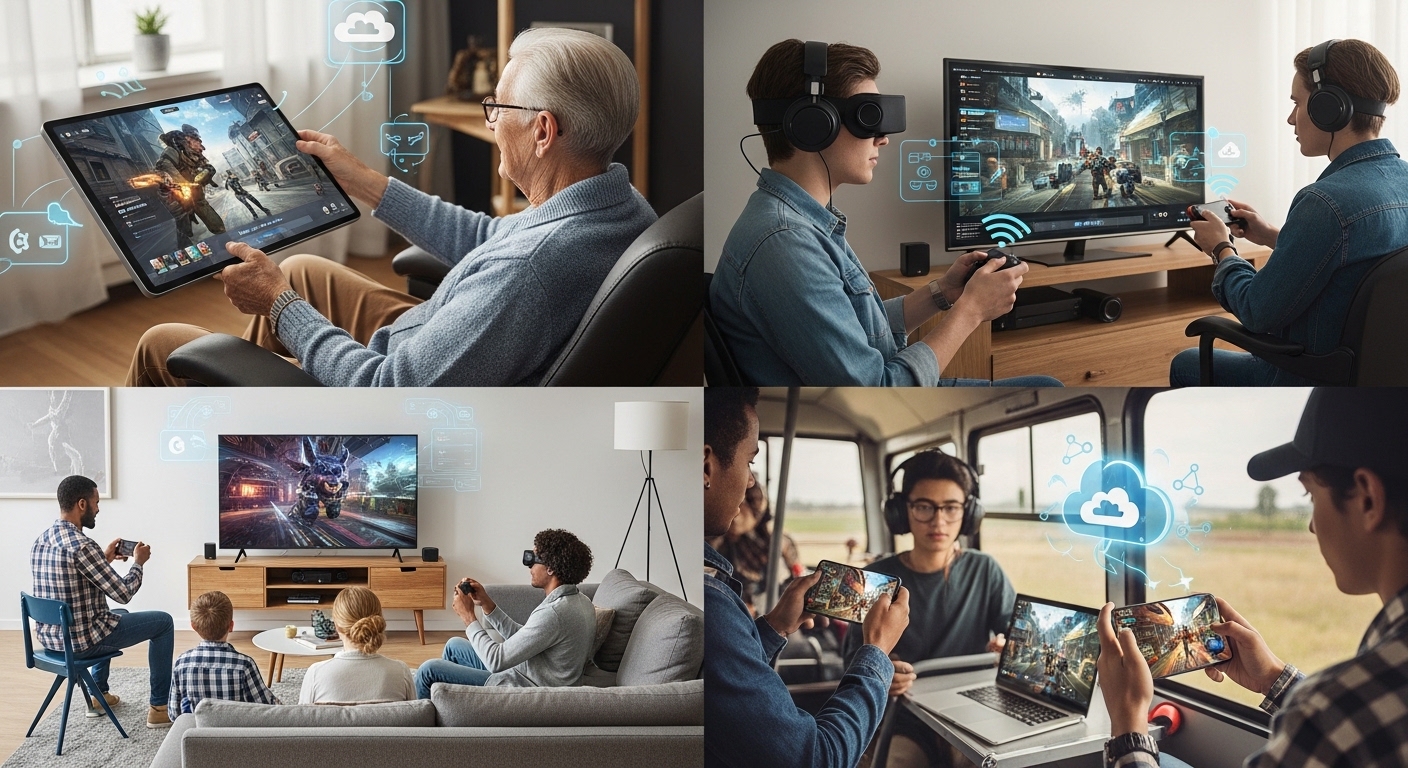
Cloud gaming services are reshaping the global gaming industry by eliminating traditional hardware barriers and expanding accessibility. For decades, participating in advanced online gaming required expensive consoles or high-performance gaming PCs. However, with the development of game streaming technology, users can now access high-quality titles without downloading or installing them locally. Instead, games are processed in remote data centers and streamed directly to devices such as smartphones, tablets, laptops, and smart TVs. This shift is revolutionizing digital entertainment by making immersive gaming experiences available to a much wider audience.
The transformation brought by cloud gaming services goes beyond convenience. It directly addresses cost, accessibility, and flexibility challenges that previously limited participation in gaming platforms. By leveraging cloud infrastructure, companies can deliver seamless gameplay without requiring users to upgrade their devices constantly. As internet penetration improves worldwide, online gaming becomes more inclusive, offering opportunities for students, casual gamers, and users in emerging markets to access premium content. This evolution represents a fundamental change in how digital entertainment is consumed.
How Cloud Gaming Services Work and Their Technological Foundation
Cloud gaming services operate through advanced cloud computing and high-speed internet connectivity. When a user selects a game, the processing occurs in powerful remote servers. The video output is then delivered to the player’s screen in real time, while their inputs are transmitted back to the server instantly. This real-time exchange enables smooth game streaming without requiring powerful hardware at the user’s end.
Major technology companies such as Microsoft, NVIDIA, and Sony have heavily invested in cloud gaming services to strengthen their gaming platforms. Services like Xbox Cloud Gaming and NVIDIA GeForce Now demonstrate how game streaming can provide console-quality experiences on basic devices. These platforms integrate powerful GPUs in remote servers, ensuring high frame rates and minimal latency when internet conditions are stable.
The technical infrastructure behind cloud gaming services also supports scalability. Unlike traditional gaming platforms that depend on physical hardware upgrades, cloud systems can expand server capacity dynamically. This flexibility enhances the reliability of online gaming ecosystems while maintaining consistent performance standards for digital entertainment experiences.
Accessibility Benefits Compared to Traditional Gaming Models
One of the most significant advantages of cloud gaming services is the reduction in upfront costs. Traditional gaming models require purchasing consoles, controllers, and sometimes expensive graphic cards. In contrast, game streaming allows players to subscribe to a service and access a library of games instantly. This affordability makes online gaming accessible to a broader demographic, including users who may not be able to invest heavily in hardware.
Another major benefit is cross-device compatibility. Modern gaming platforms powered by cloud infrastructure allow players to switch between devices seamlessly. A user can start playing on a laptop and continue on a smartphone without losing progress. This flexibility aligns perfectly with current digital entertainment consumption habits, where users expect mobility and convenience.
Additionally, cloud gaming services eliminate storage limitations. Since games run on remote servers, users do not need to worry about disk space or lengthy downloads. Updates and patches are handled centrally, ensuring that all players access the latest version instantly. This centralized approach enhances the overall online gaming experience and reduces technical frustrations commonly associated with traditional gaming systems.
Comparison Table: Traditional Gaming vs Cloud Gaming Services
The table below highlights the differences between traditional gaming platforms and cloud gaming services in terms of accessibility and functionality:
| Feature | Traditional Gaming | Cloud Gaming Services |
|---|---|---|
| Hardware Requirement | High-end console or gaming PC | Basic device with internet connection |
| Upfront Cost | Expensive hardware purchase | Subscription-based model |
| Game Installation | Required with large storage space | No installation, instant game streaming |
| Updates & Maintenance | Manual downloads and updates | Automatic server-side updates |
| Device Flexibility | Limited to specific hardware | Multi-device compatibility |
| Accessibility | Restricted by cost and hardware | Broad access through internet connectivity |
This comparison clearly shows how cloud gaming services significantly improve accessibility while maintaining performance quality. By removing hardware dependency, game streaming democratizes access to premium gaming platforms and expands digital entertainment opportunities globally.
Challenges and Future Outlook of Cloud Gaming Services
Despite their advantages, cloud gaming services face certain challenges. The most notable issue is internet dependency. High-quality game streaming requires stable broadband connections with low latency. In regions where internet infrastructure is weak, online gaming experiences may suffer from lag or buffering. However, ongoing advancements in 5G technology and fiber-optic networks are expected to minimize these limitations over time.
Another challenge involves data consumption. Streaming high-resolution games can consume significant bandwidth, which may increase internet costs for some users. Additionally, concerns about server outages or subscription pricing models remain part of ongoing discussions in the digital entertainment industry. Nevertheless, as cloud infrastructure continues to improve, these challenges are gradually being addressed.
Looking ahead, cloud gaming services are likely to integrate with emerging technologies such as artificial intelligence and virtual reality. As gaming platforms evolve, personalization, adaptive streaming, and predictive performance optimization will further enhance online gaming accessibility. With continuous innovation, game streaming is poised to become a dominant model in the global digital entertainment ecosystem.
Final Thoughts
Cloud gaming services represent a transformative shift in how people access and experience digital entertainment. By leveraging advanced cloud computing and real-time game streaming, these services remove financial and technical barriers that once restricted participation in online gaming. Modern gaming platforms now prioritize accessibility, flexibility, and affordability, ensuring that more users can engage with immersive gaming experiences regardless of their hardware limitations.
As internet infrastructure improves and technology continues to evolve, cloud gaming services will likely play an even greater role in shaping the future of digital entertainment. Their ability to democratize access, streamline performance, and expand online gaming opportunities marks a new era of inclusivity within the global gaming industry.