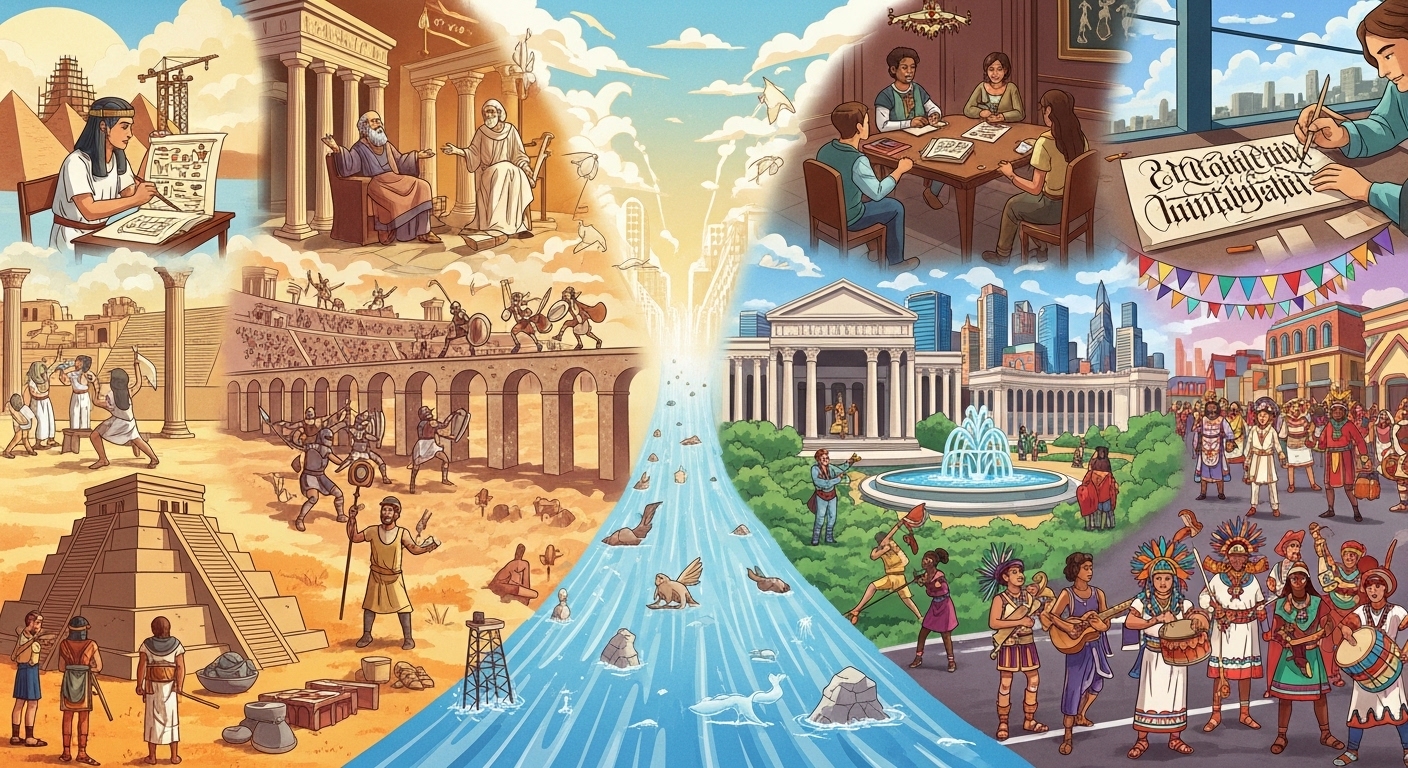
Ancient civilizations represent some of the earliest organized human societies that laid the foundations for modern culture, governance, technology, and traditions. From the river valley societies of Mesopotamia and Egypt to the philosophical and political advancements of Greece and Rome, these early societies shaped many aspects of world history that continue to influence modern life. The cultural heritage left behind by ancient civilizations is reflected in architecture, language, legal systems, art, and social traditions that remain visible even today.
Studying ancient civilizations helps us understand how human societies developed systems for agriculture, trade, governance, and religion. These early innovations created patterns of social organization that influenced future generations. The historical influence of ancient societies extends beyond their time, affecting how modern communities celebrate traditions, structure governments, and interpret cultural identity. By examining the contributions of early societies, historians can trace the origins of many customs and practices that still exist in contemporary culture.
Contributions of Early Societies to Cultural Heritage
Early societies developed complex cultures that included language, art, religion, and architecture. These elements formed the basis of cultural heritage passed down through generations. For example, ancient Egyptian civilization left behind monumental architecture such as pyramids and temples, reflecting both technological achievement and spiritual beliefs. These structures continue to inspire architectural design and historical curiosity today.
Similarly, the civilizations of ancient Greece and Rome made major contributions to philosophy, literature, and political thought. Greek philosophers explored ideas about ethics, democracy, and education that still influence modern political systems and educational philosophies. Roman civilization developed legal systems and engineering techniques that shaped governance and infrastructure in many parts of the world.
Another important aspect of cultural heritage is mythology and storytelling. Many ancient civilizations created myths to explain natural events and human experiences. These stories were preserved through literature and oral traditions, influencing modern storytelling, art, and cultural celebrations. The historical influence of these narratives continues to shape cultural identity in various societies.
Key Ancient Civilizations and Their Lasting Impact
Throughout world history, several ancient civilizations have had particularly significant influence on modern society. Each of these early societies contributed unique advancements that helped shape cultural traditions and social systems.
The following table highlights some major ancient civilizations and their key contributions.
| Ancient Civilization | Key Contribution | Modern Influence |
|---|---|---|
| Mesopotamia | Development of writing systems | Foundation of written communication |
| Egypt | Monumental architecture and religion | Cultural symbolism and architecture |
| Greece | Philosophy and democratic ideas | Political systems and education |
| Rome | Law and engineering | Legal frameworks and infrastructure |
| Indus Valley | Urban planning and sanitation | City design and public health |
These civilizations demonstrate how early societies influenced various aspects of modern cultural traditions and societal development.
Influence of Ancient Civilizations on Modern Traditions
Many modern cultural traditions can be traced back to practices established by ancient civilizations. Festivals, religious ceremonies, and artistic expressions often originate from rituals practiced by early societies. For example, harvest festivals celebrated in different cultures have roots in ancient agricultural traditions where communities honored seasonal cycles and agricultural success.
Language is another area where historical influence remains strong. Many modern languages contain words and grammatical structures derived from ancient languages such as Latin, Greek, and Sanskrit. These linguistic connections illustrate how ancient civilizations shaped communication systems that continue to evolve today.
Architecture and urban design also reflect the influence of ancient societies. Classical architectural styles inspired by Greek and Roman structures can still be seen in government buildings, museums, and universities around the world. Columns, arches, and symmetrical designs are examples of architectural elements inherited from these early civilizations.
Cultural traditions related to education and intellectual inquiry also have roots in ancient societies. Institutions of learning, public debates, and scholarly discussions were prominent in civilizations like Greece and India. These traditions helped establish the concept of formal education and intellectual exploration that continues to shape modern academic systems.
Preservation of Cultural Heritage and Historical Knowledge
Preserving the legacy of ancient civilizations is essential for understanding the development of human societies. Archaeological discoveries, historical documents, and preserved monuments provide valuable insights into how early societies functioned. Museums, research institutions, and educational programs play a vital role in protecting and sharing this knowledge with future generations.
Modern technology has enhanced the ability to study and preserve cultural heritage. Digital mapping, satellite imagery, and advanced archaeological methods allow researchers to uncover hidden sites and analyze ancient artifacts more accurately. These technologies help historians reconstruct historical narratives and better understand the contributions of ancient civilizations.
Cultural heritage preservation also promotes appreciation for diversity and global history. By learning about early societies, people gain insight into different ways of life and the challenges faced by ancient communities. This knowledge encourages respect for cultural traditions and historical achievements.
Educational programs often incorporate lessons about world history and ancient civilizations to help students understand the roots of modern society. Through these studies, learners recognize the interconnected nature of historical developments and cultural traditions.
Relevance of Ancient Civilizations in the Modern World
Although thousands of years have passed since many ancient civilizations existed, their influence remains deeply embedded in modern life. Concepts such as governance, legal rights, architectural design, and artistic expression have evolved from ideas introduced by early societies. These contributions continue to guide contemporary practices and cultural identities.
The study of ancient civilizations also reminds modern societies of the importance of innovation and cultural exchange. Early societies developed complex systems through cooperation, experimentation, and adaptation. Their achievements demonstrate how human creativity and knowledge can shape the development of civilization.
Understanding historical influence also provides perspective on modern challenges. By examining how ancient societies managed resources, organized communities, and addressed social issues, historians and policymakers can draw lessons applicable to contemporary society.
The cultural heritage of ancient civilizations serves as a bridge connecting past achievements with present-day progress. It reminds humanity of shared origins and the collective journey of human development.
Final Thought
Ancient civilizations played a crucial role in shaping the cultural traditions, social systems, and intellectual foundations of modern society. Through their contributions to world history, cultural heritage, and early societal development, these civilizations left a lasting historical influence that continues to guide contemporary life. By studying and preserving the legacy of ancient societies, modern communities can better understand the origins of their traditions and appreciate the remarkable achievements of humanity’s earliest civilizations.